Cowgirl with Lasso - Watercolor: A Crafts Branding Review
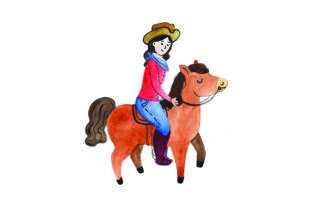
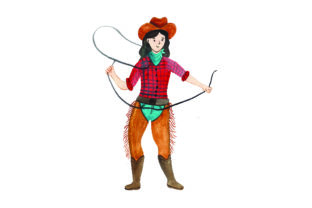
As a brand designer who works closely with local makers, I’m always searching for design assets that feel more like a signature than a generic clipart. When I first saw Cowgirl with Lasso - Watercolor, I immediately envisioned it on a candle label for a boutique ranch-style brand, on the front of a handmade soap box, or as the hero graphic for a farmer’s market stall. The piece is a watercolor illustration of a cowgirl spinning a lasso, rendered with deliberately loose, expressive brushstrokes. It’s not stiff or overly detailed—instead, it carries an organic energy that many small businesses in the crafts and homestead niche desperately need to differentiate themselves from mass-produced competitors.
The first thing that struck me was the mood. This isn’t a loud, cartoonish Western icon. The watercolor technique gives it a soft, almost sun-faded quality, like a well-loved postcard from the past. There’s a gentle femininity to the figure, but the dynamic lasso line adds motion and a hint of daring. That duality makes Cowgirl with Lasso - Watercolor surprisingly adaptable. For a handmade soap business, it evokes a sense of natural, handcrafted care. For a children’s boutique, it feels playful and whimsical. For a coffee shop with a rustic, country aesthetic, it can anchor a logo or a menu with a sense of place. In all cases, it provides a story—something that builds an emotional connection with customers before they even read a word.
From a technical standpoint, the asset is delivered in four core formats: SVG, Transparent PNG, EPS, and DXF. This is a crucial detail for any serious branding project. The SVG and EPS files are fully scalable vectors, meaning I can enlarge the cowgirl to the size of a storefront window graphic without losing an ounce of quality. That’s essential for consistent professional branding across print and digital. The Transparent PNG is perfect for quick product mockups in Canva or Photoshop, where I need to drop the illustration onto a kraft paper background or a linen texture. And the DXF file opens up possibilities for physical crafts—think laser-cut wood signage, leather stamping, or even custom stencils for a handmade business.
In my recent project for a small lavender farm, I used Cowgirl with Lasso - Watercolor as the centerpiece of their new product label. The farm sells dried lavender bundles, sachets, and hand-poured candles. I placed the watercolor illustration at the top of a rectangular label, arching the farm’s name above it in a delicate serif font. The cowgirl’s soft colors—muted teals, dusty roses, and warm earth tones—blended beautifully with the lavender sprigs I added as a secondary graphic. The result was a label that felt both premium and homespun, exactly what the client wanted. The same illustration later appeared on their thank-you cards, which are tucked into every online order. That small touch of consistency, from packaging to unboxing, significantly improved the perceived value of their products. Customers now recognize the cowgirl as a symbol of the brand’s identity.
Where This Crafts Graphic Amplifies Small Business Visuals
Not every graphic asset is built for the real-world demands of local business. I’ve evaluated hundreds, and many fail when scaled down on a product label or when printed on textured paper. Cowgirl with Lasso - Watercolor holds up remarkably well, but its impact depends on the application. Here’s where it truly shines:
- Product labels and packaging accents: The watercolor texture feels tactile, even on a glossy label, adding a layer of sophistication. It’s ideal for candles, soaps, honey jars, or artisan food products.
- Hero graphics for social media and website banners: The illustration’s composition draws the eye inward, making it a natural focal point for announcements or sales campaigns.
- Thank-you cards and printed inserts: A small, centered version of the cowgirl with a handwritten-style “Thank You” underneath creates a memorable unboxing moment.
- Seasonal packaging and promotional material: For a fall harvest box or a summer rodeo-themed event, this asset immediately sets the scene.
- Boutique window displays and signage: When printed large on a canvas or acrylic, the watercolor effect becomes a piece of art that attracts foot traffic.
However, I always caution my clients about using an illustration with this much personality in the wrong context. Here’s where restraint is key:
- Extremely small labels: On a lip balm tube or a pen, the fine watercolor details may become muddy. Always test at actual size before committing.
- Crowded layouts with heavy text: The cowgirl needs breathing room. If you pair it with a dense ingredient list or a large logo, the visual hierarchy collapses. Let it be the star, or use it subtly as a background element.
- Formal corporate documents: This is not for a law firm or a financial institution. It’s designed for brands that embrace warmth and personality.
- Low-contrast backgrounds: The watercolor’s light washes can disappear on a pale cream or beige unless you add a subtle shadow or a contrasting border.
- Luxury minimalist branding: If your brand relies on stark white space and geometric sans-serif fonts, the cowgirl might feel too illustrative. It fits better with organic, handmade, or narrative-driven aesthetics.
Designer’s Field Notes: Making the Most of this Watercolor Asset
When I integrate a new graphic into a client’s brand identity, I follow a set of checks that go beyond the preview image. With Cowgirl with Lasso - Watercolor, I ran through my usual protocol and noted a few things that can save a small business owner time and money.
First, always test on a real product mockup. I placed the PNG file on a candle jar mockup with a kraft label, a white label, and a clear sticker. The transparent PNG with its soft edges looked exquisite on the kraft—it almost seemed printed directly onto the paper. On the white label, the watercolor needed a slight boost in contrast, which I easily achieved by adjusting the brightness in the design software. The SVG version allowed me to separate the lasso and the figure if I wanted to animate them for a social media post, but I kept them together for most branding. The vector editability is a huge plus for any designer who needs to recolor a specific element to match brand colors. I tested the asset with a warm terracotta brand palette, and the cowgirl’s muted tones accepted the color overlay without losing the watercolor texture.
I also tested the graphic in black and white—a critical step for any professional branding that might need to be faxed, photocopied, or used in a single-color print. The linework holds up, but the watercolor washes lose their nuance. For black-and-white applications, I recommend using a simplified solid version of the illustration, or carefully thresholding the image. The SVG makes this possible.
Font pairing is another area where this asset reveals its versatility. I tried it alongside a classic serif (Playfair Display), a clean sans-serif (Montserrat), a flowing script (Great Vibes), a rustic handwritten font (Amatic SC), and a bold display font (Bebas Neue). The watercolor cowgirl paired beautifully with the serif and script fonts, reinforcing a vintage, feminine feel. With the sans-serif, it created an interesting contrast between organic and modern, which could work for a contemporary farm-to-table brand. The handwritten font made it too informal, competing with the illustration’s own hand-drawn quality. For the strongest visual hierarchy, I set the product name in a serif font above the cowgirl and the supporting text in a light sans-serif below. That arrangement kept the illustration as the focal point while ensuring all information was readable.
One of the most important aspects I always discuss with clients is the commercial license. Before using Cowgirl with Lasso - Watercolor on any product for sale—whether physical candles, digital downloads, or branded merchandise—you must confirm that the license permits commercial use. Many design assets from creative marketplaces are sold with a standard license that covers personal or limited commercial use, but for full-scale branding and product packaging, you may need an extended commercial license. Always read the terms. I’ve had clients nearly lose their entire branding investment because they assumed a license covered product labels when it did not. This cowgirl illustration is a powerful graphic design asset, but its legal use must be squared away first.
Building a Cohesive Brand Story with a Single Illustration
One of the most rewarding parts of my work is seeing how a well-chosen illustration can unify a small business’s entire visual presence. A local bakery I worked with used Cowgirl with Lasso - Watercolor as the jumping-off point for their brand. They sell sourdough bread and pies at a weekly market, and their packaging was a mix of brown paper bags and hand-stamped logos. We took the cowgirl and used it as the hero on their pie boxes, on a stamp for their bread bags, and on a large sidewalk sign. The owner told me that customers started recognizing the cowgirl before they even read the bakery’s name. That’s the power of a consistent, memorable image. It’s more than a pretty picture; it’s a shortcut to better product recognition and improved customer trust.
For a handmade business owner reading this, consider how this illustration could serve as the emotional thread through your materials. Print it on a hang tag for your knit goods, use it as a sticker seal on your soap boxes, or feature it on the cover of your seasonal lookbook. Because it’s a watercolor, it also prints beautifully on textured paper, giving a tactile quality that reinforces the handmade nature of your products. I’ve seen it used on a printable design for a digital recipe card, on a Canva template for a workshop flyer, and as a social media graphics element for a weekly “Farmhouse Friday” post. In each case, it added a layer of polish that felt approachable, not corporate.
If you’re a local business owner experimenting with packaging design, start by placing the Cowgirl with Lasso - Watercolor on a flat product mockup. Experiment with different placements: centered and large for a bold statement, or small and tucked into a corner for a subtle brand accent. Pay attention to how the watercolor interacts with your brand colors. If your palette is cool and muted, the cowgirl’s existing hues might blend in too much; you can use the vector file to adjust the opacity or add a warm overlay. The goal is to make the illustration feel like it was custom-made for your brand, even though it’s a purchased asset. With a little design finesse, that’s entirely achievable.
From Digital File to Real-World Impact
Ultimately, the value of any digital product in branding is measured by how it translates into the physical world. When I hand a client a finished candle with the cowgirl label, or when I see a customer smile at a thank-you card featuring that watercolor illustration, I know the asset has done its job. Cowgirl with Lasso - Watercolor is a rare find in the crafts category because it balances artistic character with practical usability. The SVG and EPS files ensure it can be scaled for any project, the PNG transparency speeds up mockup creation, and the DXF format opens doors to tangible crafts. For small business branding, especially in the local, handmade, and boutique spaces, this illustration is a quiet but powerful tool. It won’t do the work for you—you still need a thoughtful layout, complementary fonts, and a clear brand strategy—but it provides a visual anchor that can elevate your entire presentation.
I’ll be using Cowgirl with Lasso - Watercolor again for a local florist’s seasonal campaign next month, and I’m confident it will bring the same warmth and recognition it has to other projects. If you’re considering it for your own crafts-based brand, take the time to test it thoroughly, respect the license, and then let it tell your story. In a market crowded with generic designs, a piece with this much personality can be the difference between a product that blends in and one that lingers in a customer’s memory.